Mobile Menu
Close

A Simple Check For Mouth Cancer Could Save Your Life

{ News - Nothing but the tooth }

Mar 2022
14th
14th of March 2022

Mouth cancer is on the rise in the UK with over 2,700 people dying from the disease last year. This is an increase of almost 50% compared to 10 years ago which is a huge increase. One of the main issues is that over 45% of all mouth cancers are diagnosed in the late stages which means that the survival rate is much lower than early diagnosis. Not only this, but treatment is often far less invasive when caught early on leading to a far higher quality of life. During each dental examination at Progressive Dentistry, we undertake a thorough analysis of mouth cancer but with check ups usually every 6 months, we are encouraging our patients to check their mouth once a month for signs of the dreadful disease.
 

Self Checking For Mouth Cancer

A simple self check for mouth cancer should take just 30-45 seconds. 

There are 3 essential self check signs to look for: 

1. Ulcers that do not heal within 3 weeks 
2. Red or white patches ( both together is often a tell tale sign) 
3. Lumps or swellings 

Start by looking in the mirror (obvious, we know!) and stick your tongue out. Then move the tongue left and right and then up in the air looking at the floor of the mouth as well. Next, stretch your cheeks out with your fingers and check the gum line. Try to look at the cheek surfaces and the palate. Here's a simple tip for a self check- always use a well lit room or be close to natural daylight. If you see anything unusual, such as in the image below, please call your dentist or contact us for advise. We posted a more in depth article here.
 

Mouth cancer 2022 03 14 174128 kinc

Image courtesy of British and Irish Society of Oral Medicine.

Mouth Cancer Symptoms

As with many serious diseases, there may be little or no mouth cancer symptoms in the early stages. However, certain signs to look for are persistent hoarseness or sore throat, numbness or tingling on the lip or tongue, painful non healing ulcers and tightness on the tongue on movements or eating. 

Other mouth cancer symptoms to look out for:

a. Difficulty swallowing

b. Sudden speech problems

c. Weight loss

d. Bad breath

e. Lump or thickening of your lip

f. Lump in your mouth or throat

g. Unusual bleeding or numbness in your mouth

h. Loose teeth for no clear reason

i. Difficulty moving your jaw

j. Sore throat that does not get better after a few days

k. Pain in your ear that does not get better in a few days
 

How Do You Get Mouth Cancer?

Most of all mouth cancer cases are linked to 3 lifestyle factors:
 

1. Smoking

Smoking tobacco increases your risk by up to 10 times which is a very telling statistic. We also should make a note of smokeless tobacco such as betel nut chewing popular in South Asian communities. This can increase risk by upto 7 times.
 

2. Alcohol

Cases of mouth cancer are nearly 3 times higher in those who drink alcohol regularly. Those who drink between 10-42 units of alcohol per month could potentially be increasing their risk by upto 81%.
 

3. HPV- human papilloma virus (HPV)

Human papilloma virus (HPV) spreads through close skin-to-skin contact, usually during sexual activity including oral sex. Having more sexual partners, of any gender, increases your chances of having HPV. But in most people it does not cause any problems. For some, the virus any cause changes in the mouth leading to cancer in the future.

In the UK, vaccines are offered to at school to children in Year 8 which could save millions from getting cancer later in life. Practising safe sex and reducing the number of sexual partners could also help limit the risk of spread.
 

Mouth Cancer Awareness

Being more aware of mouth cancer as a population will help to reduce the cases and number of deaths long term. For further information, please visit https://www.dentalhealth.org/

It is vital that regular dental examinations are carried out and we would advise one every 6 months. After all, a simple check up could save your life. If it has been over 6 months since your last visit, please contact us or book online.
 

High Res IMGL6053

Dr Nissit Patel discussing a Panoral x ray with his patient. Early detection is crucial in the fight against Mouth Cancer.


Related posts

Dec 2021
7th
7th of December 2021

Mouth Cancer Self Check

The Self Check Tests- Early Diagnosis Is Key

There are a number of areas to check for mouth cancer. The Mouth Cancer Foundation has provided a superb self check kit which we have provided below. This will take 2 minutes and could be crucial in spotting early signs of mouth cancer. If in doubt, please book an appointment with your dentist.

FACE
 

Face


Look at the whole face. Are there any swellings you haven’t noticed before? Inspect your skin. Has anything changed recently? Have moles become larger or started to itch or bleed? Turn your head from side to side. This stretches the skin over the muscles making lumps easier to see.

NECK
 

NeckNeckNeck


Run the fingers under your jaw and feel along the large muscle either side of neck using the balls of your fingers. Are there any swellings? Does everything feel the same on both sides?

LIPS
 

LipsLips


Using your index, middle fingers and thumb to feel the inside of your mouth. Pull your upper lip upwards and bottom lip downwards to look inside for any sores or changes in colour. Use your thumb and forefinger to feel around and inside your lips checking for any lumps, bumps or changes in texture.

GUMS
 

GumsGums


Use your thumb and forefinger on the inside and outside of the gum working your way around the gum to feel for anything unusual.

CHECK YOUR CHEEKS
 

Check your CheeksCheck your Cheeks


Open your mouth and pull your cheeks away, one side at a time, with your finger to look inside. Look for any red or white patches. Use your finger in the cheek to check for ulcers, lumps or tenderness. Repeat on the other side. Your tongue can be helpful to locate sore areas, ulcers or rough patches.

TONGUE
 

TongueTongueTongue


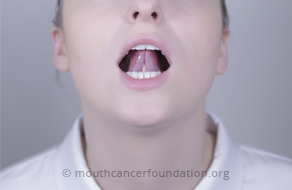
Gently pull out your tongue and look at one side first and then the other. Look for any swelling, ulcer or change in colour. Examine the underside of your tongue by lifting the tip of your tongue to the roof of your mouth.

FLOOR OF MOUTH
 

Floor of Mouth


Lift your tongue up and look underneath then look at the floor of your mouth for any colour changes that are unusual. Gently press your finger along the floor of your mouth and underside your tongue to feel for any lumps, swellings or ulcers.

ROOF OF MOUTH
 

Roof of Mouth


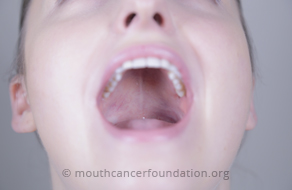
Tilt back your head and open your mouth wide to check the roof of your mouth. Look to see if there are changes in colour or ulcers. Check for changes in texture with your finger.

Make a note of anything unusual. If you have recently had a cold, sore throat, ulcer or swollen glands, bitten or scolded yourself for example, these should heal within 3 weeks. If you have any concerns visit your dentist or doctor to see if you need specialist advice.


Dec 2021
2nd
2nd of December 2021

Risk Factors & Causes of Mouth Cancer - What To Know

We don’t know what causes most mouth cancers. However, there are several factors that are likely to increase your risk.

Up to 90% of all mouth cancers are linked to lifestyle factors.

This means that with a few small changes, you can help cut your chances of developing mouth cancer.

If you do not stop or reduce the things that might put you at greater risk, it is important that you self check at home and regularly visit your dentist.

The below causes are linked to mouth cancer.


Jan 2020
15th
15th of January 2020

Canker Sores (Ulcers) And How To Manage Them

We're sure that at least once in your life, you've experienced a canker sore (ulcer). While they aren't any of an issue to your health, they can be extremely annoying, as they can leave you in a state of immense pain while eating or even moving your mouth. Fortunately, though, they don't last forever. After a few days, they tend to disappear on their own, as if they were never there. However, it does help to know how to get rid of them faster to shorten the ordeal you have to go through. To do that, though, you need to know how they show up in the first place.


Dec 2018
4th
4th of December 2018

Awareness of Mouth Cancer

Mouth cancer causes more deaths per number of cases than breast cancer and cervical cancer however awareness of it is relatively low. New cases have increased by 49% in the last decade and 135% compared to twenty years ago. Last year, 2722 people in the UK died from mouth cancer. The key risk factors are: 


- Tobacco use including chewing betel nut 

- Excess alcohol (those who smoke and drink heavily are up to 30 times more likely to develop mouth cancer)

- Poor diet 

- HPV (Human Papilloma Virus) transmitted through oral sex.

Mouth cancer can develop in most parts of the mouth including the gums, lips, tongue, palate and even the throat. The most common symptoms are : 

- Persistent non healing ulcers Persistent lumps in the mouth or lymph glands 

- Pain when swallowing 

- Numbness or bleeding from the mouth 

- Changes in speech 

- Teeth that become loose for no obvious reason 

- Tooth extraction sockets not healing 

- Difficulty moving your jaw 

- Red or white patches or striations in the mouth 


Early detection is critical to a full recovery as well as life style changes. In general, if any of the symptoms have been present for more than two weeks, seek medical advice. At Progressive Dentistry, we routinely check for mouth cancer at every examination appointment with a thorough soft tissue analysis. This will involve a detailed history and a soft tissue check. During this part of the examination, we check the tongue, underneath the tongue, floor of the mouth, cheek surfaces, soft palate, hard palate and the entire gum line. 

If you have any concerns about mouth cancer or would like some general advice, please contact us.