Mobile Menu
Close

News - Nothing but the tooth

{ Dental News }

Showing 9 of 179
Dec 2021
7th
7th of December 2021

Mouth Cancer Self Check

The Self Check Tests- Early Diagnosis Is Key

There are a number of areas to check for mouth cancer. The Mouth Cancer Foundation has provided a superb self check kit which we have provided below. This will take 2 minutes and could be crucial in spotting early signs of mouth cancer. If in doubt, please book an appointment with your dentist.

FACE
 

Face


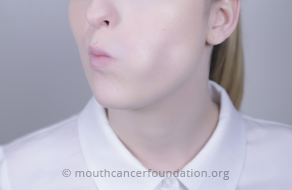
Look at the whole face. Are there any swellings you haven’t noticed before? Inspect your skin. Has anything changed recently? Have moles become larger or started to itch or bleed? Turn your head from side to side. This stretches the skin over the muscles making lumps easier to see.

NECK
 

NeckNeckNeck


Run the fingers under your jaw and feel along the large muscle either side of neck using the balls of your fingers. Are there any swellings? Does everything feel the same on both sides?

LIPS
 

LipsLips


Using your index, middle fingers and thumb to feel the inside of your mouth. Pull your upper lip upwards and bottom lip downwards to look inside for any sores or changes in colour. Use your thumb and forefinger to feel around and inside your lips checking for any lumps, bumps or changes in texture.

GUMS
 

GumsGums


Use your thumb and forefinger on the inside and outside of the gum working your way around the gum to feel for anything unusual.

CHECK YOUR CHEEKS
 

Check your CheeksCheck your Cheeks


Open your mouth and pull your cheeks away, one side at a time, with your finger to look inside. Look for any red or white patches. Use your finger in the cheek to check for ulcers, lumps or tenderness. Repeat on the other side. Your tongue can be helpful to locate sore areas, ulcers or rough patches.

TONGUE
 

TongueTongueTongue


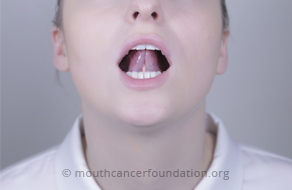
Gently pull out your tongue and look at one side first and then the other. Look for any swelling, ulcer or change in colour. Examine the underside of your tongue by lifting the tip of your tongue to the roof of your mouth.

FLOOR OF MOUTH
 

Floor of Mouth


Lift your tongue up and look underneath then look at the floor of your mouth for any colour changes that are unusual. Gently press your finger along the floor of your mouth and underside your tongue to feel for any lumps, swellings or ulcers.

ROOF OF MOUTH
 

Roof of Mouth


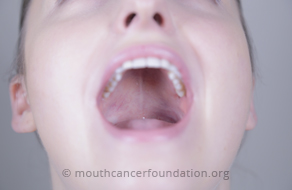
Tilt back your head and open your mouth wide to check the roof of your mouth. Look to see if there are changes in colour or ulcers. Check for changes in texture with your finger.

Make a note of anything unusual. If you have recently had a cold, sore throat, ulcer or swollen glands, bitten or scolded yourself for example, these should heal within 3 weeks. If you have any concerns visit your dentist or doctor to see if you need specialist advice.


Dec 2021
2nd
2nd of December 2021

Risk Factors & Causes of Mouth Cancer - What To Know

We don’t know what causes most mouth cancers. However, there are several factors that are likely to increase your risk.

Up to 90% of all mouth cancers are linked to lifestyle factors.

This means that with a few small changes, you can help cut your chances of developing mouth cancer.

If you do not stop or reduce the things that might put you at greater risk, it is important that you self check at home and regularly visit your dentist.

The below causes are linked to mouth cancer.


Dec 2020
24th
24th of December 2020

Merry Christmas!

We are now closed for the Christmas break and will re open on the 30th December for emergency appointments from 0900-1400. This will be by appointment only using our online booking facility. To make an appointment please use the link below:-

Tagged with:   Emergency dentist

Dec 2020
17th
17th of December 2020

Emergency Dentist at Christmas

Christmas is fast approaching and the nation prepares for a slight relaxation of the lockdown rules with mixing of up to 3 households from December 23rd to 27th which will be a welcome change albeit with likely stricter rules come January! 

During Christmas, it is normal for dental practices to close and take a well earned rest during the festive period. We are no exception and our doors will close from 1730 on 22nd December. However, if you have a dental emergency and would like to speak with a dentist, Dr Nissit Patel will still be available via video consultation for remote advice, prescriptions as required and home care instructions. To book an appointment, simply follow the links below:-


May 2020
14th
14th of May 2020

When Will Dentists Open For Emergency Treatment In London?

One of the most pressing issues in dentistry at the moment is when will we be able to re-open for emergency dental appointments. It is has been nearly 2 months since we were forced to close our doors. Despite what the Government may say, on the 25th March the Chief Dental Officer stated:

1. All routine, non-urgent dental care including orthodontics should be stopped and deferred until advised otherwise.

2. All practices should establish (independently or by collaboration with others) a remote urgent care service, providing telephone triage for their patients with urgent needs during usual working hours, and whenever possible treating with:
 
a. Advice
b. Analgesia
c. Antimicrobial means where appropriate

3. If the patient’s condition cannot be managed by these means, then they will need to be referred to the appropriate part of their Local Urgent Dental Care system. These new arrangements will involve providers working with defined groups of patients to manage urgent dental care needs only, with appropriate separation arrangements in place to manage patient status and professional safety

By all accounts, this ordered an immediate halt to all dental services within primary care. In my local area, Fulham, SW6 London, I have not been informed of a local urgent dental care centre that I am able to refer extreme emergency cases to. The advice given by various bodies ( I shall not name them) was to call 111. Frankly, this may have been almost acceptable in the early stages of the pandemic but NOT 7 weeks after the statement. Thousands of patients across the country have been left in pain and distress with the advice to take pain killers and anti biotics, which as we all know, are only effective when infection is present. 

In this respect, I spent many hours reviewing the literature to provide some evidence-based analysis on how we can protect ourselves, our patients and get back to work after lockdown. If you are interested in reading this article, it was published by Dentistry and the link is here.

The summary involves 10 key points which are easy to implement and allow us to get back to work as soon as possible. These include:
 

1. Careful screening of patients pre treatment

2. Alteration of patient appointment times/ flexible time frames

3. Reception screening, social distancing measures.

4. Consider clean air systems within reception areas and surgeries such as those involving air suctioning pre filters, HEPA filters, carbon filters and UV lamps

5. Reducing aerosol

6. Always use high volume suction or HVA

7. Use rubber dam or consider additional isolation systems such as Isovac/Isolite

8. Provide assistants to hygiene/therapists for HVA

9. Enhanced PPE especially for those at greater risk of Covid 19

10. Extra time for cleaning and disinfecting surfaces including areas not previously cleaned

These are measured points that will go a large way to help our profession back to work and re-start the process of opening our dental clinics in London and across the UK.

Should you have a dental emergency, please do not hesitate to contact me. Although we cannot see you right now, I can try to help as best as I can remotely and arrange an appointment as soon as we can re-open. 
 

www.progressivedentistry.co.uk
 

t 0207 7311162 
 

e info@progressivedentistry.co.uk 
 

Article written by Dr Nissit Patel


Apr 2020
21st
21st of April 2020

Managing Orthodontic Emergencies at Home during Lockdown

If you are undergoing orthodontic treatment at this present time, I can appreciate that it is probably quite a worry about when your next appointment may be. After all, orthodontic treatment is all about seeing progress for teeth straightening and it is unlikely the next adjustment or review appointment will be for some time yet.

However, it is important to stay positive and remember the fact that things will return to some level of normality in the near future and that teeth can always be straightened despite the time delay!

On that note, I thought it would be useful to discuss orthodontic emergencies and how to manage them at home during lock down. The most common types of problems encountered listed below with some helpful tips on how to manage them at home.


Apr 2020
8th
8th of April 2020

Where are we now with Corona Virus and Dentistry?

As of 8/4/20, there have been no general updates with regards to the provision of general dental care in a practice like ours, based in Fulham London. This is an incredibly frustrating time for of all us here especially for those of you who are in need of routine emergency dental care which could be a simple tooth fracture, a lost crown, a broken denture, a lost filling, an ulcer or gum bleeding for example. Most dental emergencies are not classified as being urgent or life threatening such as a rapidly increasing swelling, head trauma or difficult in breathing from bleeding after a tooth extraction.

Whilst we accept that the decision by the health and governing bodies are designed to stop the spread of coronavirus by limiting face to face contact between dentist and patient, this does leave many hundreds if not thousands of patients with anxiety about when their emergency can be seen to and whether the problem is going to get much worse during the delay.